
Restaurant buyer guide

Best AI chatbot for restaurants: catch the booking, never promise the kitchen.

A restaurant chatbot should make the host stand faster: menu and hours questions answered from approved copy, booking requests captured cleanly, large parties routed to a person. It should not confirm tables it cannot see, take orders it cannot place, or assure anyone a dish is allergy-safe.

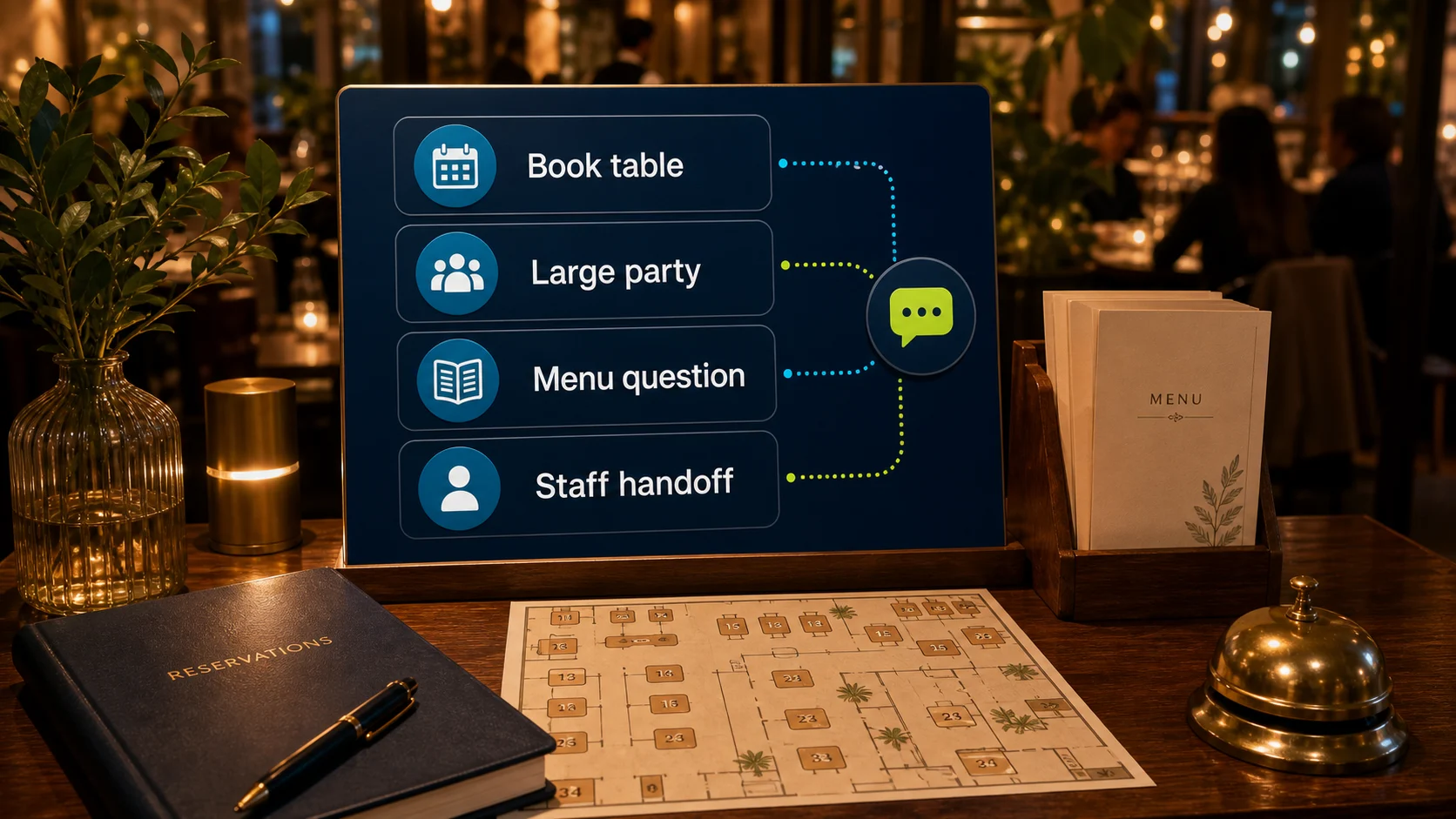
Restaurant host stand with chatbot routing for table booking, large parties, menu questions, and staff handoff.

What the visitor needs

Catch the enquiry, keep the commitments human.

A guest asks about Saturday availability for six people while service is in full swing. The chatbot answers from approved copy, collects the request, and routes the confirmation.

What the chatbot should collect

Need
Table, event, takeaway
Context
Party size, date, window
Risk
Allergens, confirmed tables, orders
Handoff
Host stand or booking system

Safe for the chatbot

A cleaner request list for front-of-house without turning the chat widget into a safety or double-booking problem.

Needs a person or approved process

No allergen assurances, confirmed tables outside a tested booking path, order-taking, or improvised discounts.

Short answer

Start with FastBots if you want a simple site-trained assistant for menu and hours questions plus booking-request capture. Look at Chatbase if tightly controlled answers from approved menu pages matter most. Choose Tidio when front-of-house should take over chats live during service, and ChatBot.com when a group or multi-location operation wants designed intake flows and team features.

The first win is not a bot that chats about food. It is a cleaner request list: who wants a table, for how many, when, and how to reach them — collected during the dinner rush and after close, when the phone is exactly where bookings currently die.

Restaurants add one boundary most industries do not have: allergen questions are safety questions. The chatbot can describe how the menu is labelled; whether a dish is safe for a specific allergy is a conversation with staff, every time.

Pricing snapshot

What the shortlist costs before you trial it.

A chatbot has to beat the cost of missed bookings. Compare the current range and usage unit against your enquiry volume before choosing.
Current as of 1 June 2026 - 7 June 2026

FastBots

Website AI chatbot

Website chat Small websites that want a trained chatbot without a broader AI-agent buildout.
Cheapest paid plan $33/mo annually Essential plan

Monthly: $39/mo

Includes: 2,000 message credits/mo across 2 bots; standard replies use 1 credit.

Typical price range
$0 to $399/mo; main paid plans run $39-$199/mo
What raises the bill
Message credits (1 standard reply = 1 credit; advanced models use 5-10), chatbot count, handoff, and branding gates

Check current price

Chatbase

Trainable website chatbot

Website chat Teams with help pages, files, Q&A, Notion, or support-ticket sources to manage.
Cheapest paid plan $32/mo annually Hobby plan

Includes: 500 message credits/mo, 1 AI agent, and 5 AI Actions/agent.

Typical price range
$0 to $400/mo annually; Enterprise is custom
What raises the bill
Message credits, AI agents, source limits, actions, seats, and add-ons
Check current price

Tidio

Website chat and support

Live support Stores that need live chat, AI help, and human handoff in one workflow.
Cheapest paid plan $24.17/mo annually Starter plan

Includes: 100 billable conversations/mo; Lyro AI is separate, with the first 50 conversations lifetime free.

Typical price range
$24.17/mo Starter to $749/mo Plus; Premium is custom
What raises the bill
Billable conversations, Lyro AI conversations, Flows visitors reached, and seats
Check current price

ChatBot.com

AI support workspace

Website chat Teams comparing AI agent, live chat, shared inbox, ticketing, and workflows in one Text workspace.
Cheapest paid plan $19/user/mo Essential plan

Monthly: $25/user/mo

Includes: 1 AI agent, 10 AI resolutions/mo, and 10,000 API calls.

Typical price range
$19-$79/user/mo annually; Enterprise is custom
What raises the bill
Per-user pricing plus included AI agents, AI resolutions, API calls, and workflow allowances
Check current price

Restaurant workflow

The bot should make the host stand faster, not braver.

A useful restaurant chatbot is an intake and routing layer, not a reservation book, order terminal, or allergen authority. It separates routine guest questions from the safety, money, and booking commitments that need people and tested systems.

What matters most

What matters for restaurants

A quick read on what matters for this buying decision.
Hours, menu, location questions Core job
Booking-request capture Phone relief
Large party and event enquiries High value
Mid-service and after-hours capture Missed-call leak
Human handoff Trust
Allergen or order promises Never automate

Choose the right layer

Website chatbot, reservation system, or ordering platform?

Restaurant language blurs three different jobs. Keep request intake, live reservations, and order operations separate before choosing a tool.
01

Website layer

Restaurant website chatbot

Best for hours, menu and dietary descriptions from approved copy, parking, policies, walk-in rules, and capturing booking and event requests for confirmation.
  • Menu FAQs
  • Booking requests
  • Event enquiries
  • Callback path
02

Reservation layer

Booking platform or tested reservation link

Useful when guests should pick a table through the reservation system the restaurant already trusts, with its own rules for party size, peak services, and no-shows.
  • Live availability
  • Party-size rules
  • Deposits
  • Reminders
03

Operations layer

POS and online ordering

Needed when the workflow touches actual orders, payments, delivery platforms, or kitchen operations — order-taking belongs here, not in a chat widget without a tested integration.
  • Orders
  • Payments
  • Delivery apps
  • Kitchen ops

Shortlist

Which tool should you check first?

Current ChatbotEdge-reviewed tools that fit restaurant website work. Reservation platforms, POS, and online-ordering systems are a separate category this guide does not score.

Lead capture

FastBots

Simple guest intake

Start here if

Restaurants that want a simple site-trained assistant for hours, menu questions, policies, and booking-request capture without extra workspace tooling.

Before you choose

Treat it as request intake plus follow-up by staff. Do not frame it as live table availability, order-taking, or anything that invites allergen-safety reliance.
Check FastBots

Answer control

Chatbase

Source-controlled answers

Start here if

Restaurants that want tightly controlled answers from approved pages — menus, dietary descriptions, policies — so the bot describes rather than improvises.

Before you choose

Source control reduces wrong answers; it does not make allergen answers safe to automate. Keep safety questions routed to staff.
Check Chatbase

Handoff

Tidio

Inbox and handoff

Start here if

Front-of-house teams that want AI answers plus live chat with operating-hours behavior, so a person can take over during service when it matters.

Before you choose

Inbox handoff is the strength; keep confirmed tables, order changes, and allergy assurances out of automated replies.
Check Tidio

Flow design

ChatBot.com

Designed flow capture

Start here if

Groups and multi-location restaurants that want designed question flows, saved attributes, and team features around guest enquiries.

Before you choose

Designed flows collect cleaner requests, but per-user pricing scales with seats and flows are not proof of reservation-system integration.
Check ChatBot.com

Booking-request flow

From guest enquiry to useful handoff.

Collect enough context for staff to confirm faster, then stop before the chatbot becomes a reservation book, order terminal, or allergen authority.
01 Visitor asks

A guest enquiry lands

The visitor asks about tonight's availability, opening hours, the menu, dietary options, parking, private dining, or whether you take walk-ins — often while the phone is ringing out mid-service.

02 Bot collects

Capture the booking-request brief

Ask for name, contact details, party size, preferred date and time window, and the occasion if the guest offers it — enough for a person or booking system to confirm quickly.

03 Boundary check

Keep safety and commitments human

The chatbot can answer from approved menu and policy copy, but allergen assurances, confirmed tables without a tested booking path, and order-taking stay with people and tested systems.

04 Handoff

Route to the host stand or booking system

Staff get a clean request list, large parties and private events get a callback, and guests with allergy questions get pointed to a person — not a promise.

What the chatbot should collect

The questions that make follow-up cleaner.

Booking request

The guest wants a table tonight, this weekend, or for a specific occasion.

Collect name, contact, party size, date, and time window, then confirm through staff or the reservation system. Do not confirm a table without a tested booking path.

Menu or dietary question

The guest asks what is gluten-free, vegan, or kid-friendly, or wants to see the menu.

Answer from approved menu copy and link the current menu. Describe how dishes are labelled; do not promise a dish is safe for a specific allergy.

Allergy question

The guest says someone in the party has an allergy and asks if a dish is safe.

Share the allergen-information page if one exists and route to staff: ask the guest to confirm directly when booking or ordering. Safety assurances never come from the widget.

Large party or private event

The guest asks about a group booking, function room, set menus, or catering.

Collect headcount, date, budget signal if offered, and contact details for a callback — these are high-value enquiries that deserve a person, not an automated quote.

Order or delivery question

The guest wants to place, change, or chase a takeaway or delivery order.

Point to the ordering platform or phone. Without a tested ordering integration, the chatbot should never take or modify an order.

Setup checklist

Set the rules before the first Saturday-night rush.

Define minimal intake fields: name, contact details, party size, date and time window, and occasion or special requests in the guest's own words.

Write approved wording for hours, address and parking, menu highlights, dietary labelling, walk-in policy, large-party rules, deposits and no-show policy, and gift cards.

Add the current menu, FAQ, private-dining, and policy pages as training sources — and keep them updated when the menu changes seasonally.

Tell the chatbot to route, not promise: no allergen assurances, no confirmed tables outside the tested booking path, no order-taking, no improvised discounts.

Decide the reservation handoff: either a person confirms every request, or the bot links into the reservation platform the restaurant already trusts.

Send transcripts to the host-stand inbox or email and test booking requests, allergy wording, mid-service behavior, after-hours behavior, and handoff failures before expanding automation.

What the chatbot should not decide alone

Safe first jobs, and what a person should keep.

The safest restaurant chatbot gathers booking requests and answers from approved menu copy. It should not touch allergen safety, confirmed tables, orders, or money.

Safe first jobs

Collect booking-request details

Name, contact details, party size, preferred date and time window, and the occasion or special request in the guest's own words.

Answer approved menu and policy FAQs

Hours, location, parking, menu descriptions and dietary labels, walk-in rules, deposits, and private-dining basics from approved copy.

Route high-stakes enquiries

Allergy questions, large parties, private events, press, and complaints go to staff with contact details captured.

Keep with a person

Anything allergen or safety

Whether a dish is safe for a specific allergy depends on kitchen practice and cross-contact on the day — that answer belongs to staff, every time.

Confirmed tables and changes

Confirmed reservations, modifications, cancellations within policy windows, and no-show calls need a person or the tested reservation system.

Orders and money

Order-taking, bill questions, refunds, deposits, and gift-card balances need tested systems with payment handling — not chat improvisation.

Do not automate first

  • Allergen-safety assurances or any wording a guest could reasonably rely on for a medical decision — describe labelling, then route to staff.
  • Confirmed reservations, table changes, or waitlist promises outside a tested reservation-system path.
  • Taking, modifying, or chasing food orders without an official, tested ordering integration.
  • Refunds, comps, discounts, or no-show fee decisions — money conversations stay with managers.
  • Health-inspection, licensing, or food-safety claims beyond what the restaurant publishes on its own site.

Specialist systems

When a chatbot is not enough.

If the real problem is live table management, deposits and no-shows, delivery-platform orders, or kitchen throughput, that is reservation-platform and POS territory — a website chatbot only solves the first step of that funnel.

We kept this shortlist to tools ChatbotEdge can describe from official sources. None of them are reservation, POS, or online-ordering systems, and we do not claim otherwise.

A practical split: the website chatbot captures and qualifies the enquiry; the reservation system owns tables and the POS owns orders. If missed phone calls hurt more than missed chats, fix that leak first — the lead-capture guide covers the phone-layer split.

Sources checked

What this guide is based on.

Product details change. Check current vendor docs before giving a chatbot any role beyond intake and approved-copy answers, and keep allergen handling with your kitchen and staff.

For the wider decision, the small-business chatbot picks page maps every starting point, the affordable chatbots guide compares entry prices, and the appointment-booking guide covers the calendar-specific claims.

FAQ

Restaurant chatbot questions.

What should a restaurant automate first with a chatbot?

Start with the questions your phone line answers all day: hours, location, parking, menu highlights, dietary options as described in approved menu copy, and whether you take walk-ins. Then add booking-request capture — name, contact, party size, date and time window, occasion — handed to a person or a tested reservation system to confirm. That alone recovers the after-hours and mid-service enquiries the phone loses. Keep allergen assurances, confirmed reservations without a tested booking path, and order-taking out of the first project.

Reviewed

Can a restaurant chatbot take reservations?

It can take reservation requests safely; it should only confirm actual bookings through a tested reservation path. The reliable pattern is: the chatbot collects party size, date, time window, and contact details, then either hands the request to staff to confirm or sends the guest into the booking system the restaurant already trusts. Letting a chatbot improvise confirmed tables — especially for large parties, peak services, or special occasions — is how double-bookings and no-show disputes happen. If you already use a reservation platform, link to it from the chat instead of recreating it.

Reviewed

Should a restaurant chatbot answer allergen questions?

It should describe, never assure. A chatbot can repeat approved menu copy — which dishes are marked gluten-free or vegan, where the allergen menu lives — but it should not promise that a dish is safe for a specific allergy, because safety depends on kitchen practice, substitutions, and cross-contact on the day. The safe wording routes the guest to a human: share the allergen information page, then advise confirming directly with staff when booking or ordering. An allergy promise is a safety commitment, and safety commitments do not belong to an automated widget.

Reviewed

How do I pick an AI chatbot for a small business?

Pick by the job before you pick by the vendor. Write down the first lost conversation in plain English — missed enquiries from service pages, repeat product questions, DMs that go unanswered, support replies that pile up overnight, or quote requests that need a person. Then match the surface: a website chatbot for site pages, a social-DM tool for comments and DMs, a WhatsApp tool for WhatsApp follow-up, a support-workspace tool when tickets and team inbox matter. Only after the job and surface are clear should you compare plans, pricing units, and handoff. The [small-business chatbot plan picker](/guides/chatbot-plan-picker-small-business) walks through the same sequence.

Reviewed

Decision recap

Pick a restaurant chatbot: the short version.

  • Start with FastBots — if you want simple menu-and-hours answers plus booking-request capture from approved copy.
  • Check Chatbase — if tightly controlled answers from approved menu and policy pages are the main concern.
  • Check Tidio — if front-of-house should take over chats live during service hours.
  • Check ChatBot.com — if a group or multi-location restaurant needs designed flows and team features.
  • Route to staff — for allergy questions, confirmed tables, orders, refunds, and anything a guest's safety or money depends on.