Message credits
FastBots, Chatbase
Useful for trained website answers, but one visitor question is not always one unit when models, replies, and extra credit rules differ.
Six-Trap Check
The real cost usually appears when usage grows, a teammate needs access, the bot needs handoff, or the workflow moves from simple answers into actions and support operations.
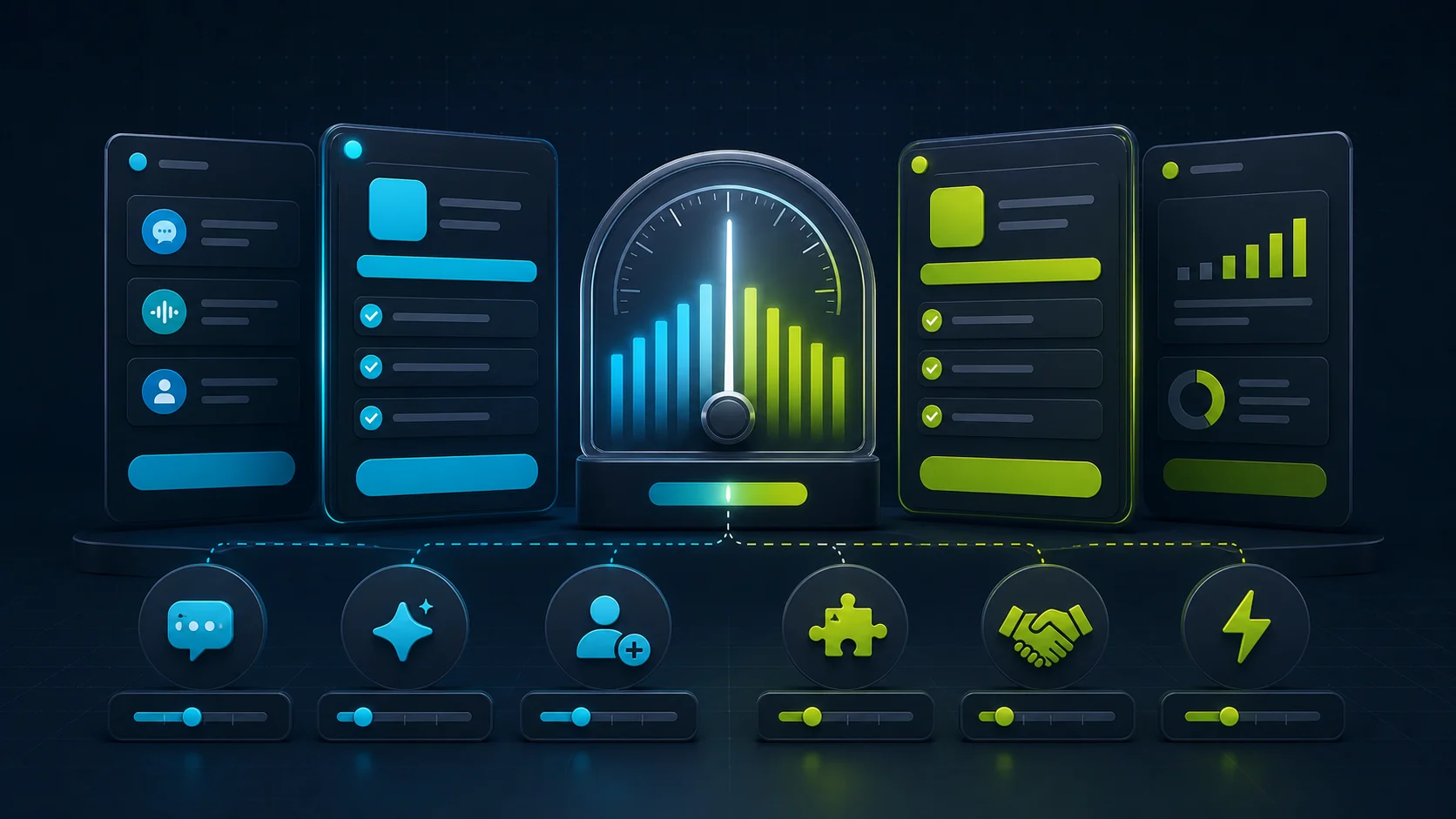
The safest way to compare AI chatbot pricing is to ignore the cheapest headline plan at first and ask what the tool charges for when it becomes useful. The common traps are message-credit burn, AI resolutions, users, handoff, source limits, actions, branding removal, API access, and extra usage packages.
For a simple website FAQ bot, FastBots or Chatbase may be easier to reason about because the first check is message credits and source capacity. For support operations, Tidio and ChatBot.com can be worth comparing, but the buyer needs to model conversations, users, AI resolution allowances, and workflow scope.
If your question is which cost grows first as the site gets busier, read the companion guide to AI chatbot scaling costs. If you are still comparing starter plans for a small website, start with what costs extra on small-site chatbot plans. If the units themselves are still unclear, start with message credits vs conversations. If you already know the job but not the tier, use the small-business chatbot plan picker.
Current pricing frame
Official pricing pages were rechecked for this article on June 6, 2026. Use them as dated planning signals, not permanent plan tables.
Sources checked
Official pricing pages
Message credits
Useful for trained website answers, but one visitor question is not always one unit when models, replies, and extra credit rules differ.
AI resolutions
A support automation metric. It should be modelled against real support conversations, not compared directly with message credits.
Billable conversations and Lyro conversations
A support-workflow setup can include live chat, Lyro AI, Flows reach, and actions rather than one simple chatbot allowance.
Seats, agents, add-ons, and production polish
Extra users, bots, custom domains, branding removal, API access, actions, or auto-refills can matter more than the entry price.
Six-Trap Check
Use this as the Six-Trap Check before turning a free trial into a production chatbot: credits, resolutions, seats, plan gates, mixed meters, and add-ons. These checks matter more than a screenshot of the lowest monthly plan.
01
FastBots and Chatbase both use message-credit language, but the credit burn can depend on the model, answer count, source setup, and whether extra credits are added later.
Buyer check: Estimate real monthly bot replies, then check what one reply costs on the model you expect to use.
02
ChatBot.com prices around users and AI agent resolutions. That is closer to support-workload automation than a simple website FAQ allowance.
Buyer check: Ask how a resolution is counted, what happens when it is exceeded, and whether extra packages are automatic.
03
A one-user support workspace can look affordable. The bill changes when an owner, dispatcher, support lead, and freelancer all need access.
Buyer check: Count the people who need to view, take over, audit, or configure conversations.
04
Human handoff, API access, actions, more bots, extra sources, workflows, or branding removal can sit on higher plans or add-ons.
Buyer check: Price the job you actually need, not only the lowest paid plan.
05
Tidio combines customer-service, Lyro AI, and Flows-style automation limits. Comparing it to a lightweight trained FAQ bot by headline price alone is misleading.
Buyer check: Separate live chat, AI conversations, automation reach, and handoff before choosing.
06
Custom domains, extra agents, extra members, extra message credits, and branding removal can matter once the chatbot is public and client-facing.
Buyer check: Make a production checklist and mark every item as included, add-on, or unavailable.
Tool-specific watchouts
Current signal
Official pricing showed Essential at $39/month or $33/month annually, Business at $89/month or $75/month annually, and Premium at $199/month or $165/month annually.
Watch before choosing
Essential includes 2,000 message credits/month. Standard models use 1 credit per reply, while advanced models shown on the pricing page can use 5-10 credits per response.
Check FastBotsCurrent signal
Official annual-view pricing showed Hobby at $32/month, Standard at $120/month, and Pro at $400/month, each billed annually. Check the monthly toggle before budgeting month to month.
Watch before choosing
The bill can move through message credits, AI agents, extra team members, custom domains, branding removal, AI actions, and auto-recharge behavior.
Check Chatbase pricingCurrent signal
Official pricing showed Starter at $24.17/month, Growth at $49.17/month, and Plus at $749/month in the checked annual-view output.
Watch before choosing
Tidio combines billable conversations, Lyro AI conversations, Flows visitors reached, actions, and support-workflow scope. Higher quotas move into Plus or Premium/custom conversations.
Check Tidio pricingCurrent signal
Official pricing showed Essential at $19/user/month annually or $25/user/month monthly, and Growth at $79/user/month annually or $99/user/month monthly.
Watch before choosing
AI agent resolutions, AI agents, workflows, and users all matter. The pricing calculator also exposes extra AI-resolution packages when usage exceeds plan limits.
Check ChatBot.comScenario checks
Before you start a trial, make a rough bill model for the job you actually want the chatbot to do. This does not need to be perfect; it only needs to expose the first plan jump before the bot is live.
01
Decide whether the bot is answering public pages, qualifying leads, resolving support issues, or triggering a workflow. Each job points at a different pricing meter.
02
Write down likely bot replies, support conversations, teammates, source files, handoffs, and actions. Add a high case so the first successful month is not a surprise.
03
Check which plan you need if replies double, a second teammate joins, branding needs removal, or a tested action becomes necessary.
04
Decide whether extra credits, AI resolutions, add-ons, or workflow changes can start automatically, or need owner approval first.
| Buyer job | First cost unit to inspect | Why it matters |
|---|---|---|
| Small brochure site | Replies and source size | Start with message credits, crawl limits, files, and the cost of extra replies. |
| Local-service quote intake | Pricing-source and workflow gates | Check whether the tool can collect details, read approved prices or call a tested calculator action, and avoid promising bookings untested. |
| Support inbox | Seats and resolutions | Model the team that needs access and the number of support conversations AI may resolve. |
| Ecommerce store | Product data and actions | Separate product answers from order lookup, account actions, cart edits, discounts, and returns workflows. |
| Agency or consultant | Branding and client scale | Check extra bots, workspace members, custom branding, domains, and client-specific source limits. |
Buying checklist
A good chatbot plan is not the one with the lowest entry price. It is the one where the next three usage steps are still acceptable.
Sources checked
Sources were checked on June 6, 2026. Pricing pages can be personalized, dynamic, or updated without notice, so use this guide to know what to inspect rather than to freeze a permanent plan table.
FAQ
The biggest trap is comparing headline monthly prices instead of the billing unit. Some tools meter message credits, some meter AI resolutions, some charge per user, and some move important workflow features into higher plans or add-ons.
Reviewed
Choose the cheapest plan only if it includes the workflow you actually need. A low entry plan can be fine for website answers, but support handoff, actions, API access, branding removal, seats, and extra usage can change the real cost.
Reviewed
Overage behaviour differs sharply between vendors and is the most under-priced part of a small-site comparison. ChatBot.com automatically tops up: when you hit your monthly limit, Text automatically adds 50 more resolutions, and anything used gets billed at your next renewal. FastBots takes the opposite approach, saying you can easily buy more credits to add to your account or just upgrade to a higher plan with more message credits. Auto-billing pack overages are convenient but can produce a surprise invoice; manual top-ups give cost control but can break the bot during a busy period. Decide which behaviour fits the team before signing.
Reviewed · Sourced from ChatBot.com pricing , FastBots pricing
Yes, on platforms that bill in message credits. FastBots documents this directly: GPT-4o = 5 Message credits per response, while GPT-4o Mini = 1 Message credits per response. That means a chatbot pointed at a frontier model can consume credits five times faster than the same chatbot pointed at a small model, with no change in visitor volume. Before settling on a plan, decide which model the chatbot will actually use in production and stress-test the credit burn against a realistic month of replies.
Reviewed · Sourced from FastBots pricing
On most tools, yes. Branding removal is a common upsell rather than a feature included in the entry plan. Chatbase sells a branding add-on whose pricing page tagline says it will remove the Chatbase branding from your deployed agents. FastBots gates branding control behind higher tiers and notes a Premium-plan option to hide FastBots branding on widgets. If the chatbot needs to look like part of the brand from day one (consultant, agency, ecommerce), price the branding step explicitly. See the companion AI chatbot pricing traps guide for how branding removal interacts with other usage meters.
Reviewed · Sourced from Chatbase pricing , FastBots pricing
Free tiers are useful for a one-week test, not for a production launch. Chatbase 's Free plan lists 50 message credits/month and 0 AI Actions per AI agent — usable for a demo, but the action limit alone blocks Shopify or CRM workflows. Tidio 's pricing page documents 50 Lyro AI Agent conversations (one-off) on the Starter tier, which is a non-renewing allowance. Free tiers are great for proving the concept and showing internal stakeholders, but the budget for the first real month needs to assume a paid plan on whichever tool clears the trial.
Reviewed · Sourced from Chatbase pricing , Tidio pricing
There is no single answer because the cheap-looking entry plan is not always the usable one. For a brochure site with mostly source-trained Q&A, FastBots Essential and Chatbase Hobby are the two starter plans to inspect first. For a support-led store with live chat and inbox needs, Tidio Starter is the natural first check, and Lyro is a separate add-on on top of that. If the team already runs on a per-seat help-desk model, ChatBot.com by Text starts at $19 per user/month (billed annually) for the Essential plan, which includes an AI chatbot, live chat, a shared inbox, and a ticketing system. Pick around the workflow, not the headline figure.
Reviewed · Sourced from ChatBot.com pricing
Decision recap