
FastBots
Website AI chatbot- Range
- $0 to $399/mo; main paid plans run $39-$199/mo
- Entry paid
- Essential is $39/mo, or $33/mo when billed annually
- Check
- Message credits, chatbot count, human takeover, and branding removal gates
Cleaning buyer guide
A cleaning chatbot should not promise a price, judge site condition, or confirm a cleaner. Its job is to collect the quote brief, answer approved FAQs, and hand off before trust breaks.
Cleaning intake
Boundary
No final price, site-condition judgement, hazardous-cleanup advice, cleaner promise, or confirmed booking.Outcome
Cleaner quote enquiries without turning the chatbot into a cleaning operations system.Start with FastBots if you want a straightforward site-trained assistant to collect cleaning quote details and route leads. Look at Chatbase if controlled answers from approved service pages, policies, and checklists are the main risk. Choose Tidio if live chat, tickets, lead collection, and inbox handoff matter. Consider ChatBot.com when you want a broader support workspace rather than a simple quote-intake bot.
The first win is fewer half-useful quote requests: location, service type, property size, bedrooms, bathrooms, frequency, timing, pets, access notes, special conditions, photos or description, and a clear callback or human-review path.
Keep the chatbot as intake and routing. Exact prices, condition adjustments, specialty or hazardous cleaning, cleaner assignment, recurring schedules, and final service commitments should stay with a qualified person and the business's approved process. The broader AI chatbot quote-request guide covers this pricing boundary across local-service and ecommerce use cases. For another service business where photos and estimate details matter, compare the AI chatbot for painters guide. For recurring maintenance and repair intake with sharper chemistry and route boundaries, see the pool service chatbot guide. For treatment-sensitive intake where the bot should stop before diagnosis and chemical promises, compare the pest-control chatbot guide.
Pricing snapshot
Cleaning workflow
A useful cleaning chatbot is an intake and routing layer, not an estimator, cleaner scheduler, operations calendar, quote calculator, or hazardous-cleaning adviser. It should separate routine cleaning enquiries from questions that need a qualified human review.
Workflow weighting
Fit map
Best first use
Bedrooms, baths, sqft
Service pages and FAQs
Good fit
Quote review
Proof needed
Keep out of scope
Choose the right layer
Website layer
Reception layer
Ops layer
Tool-fit matrix
Simple site-trained lead intake
Best when
Cleaning companies that want a simple site-trained assistant to collect name, phone, suburb, service type, bedrooms, bathrooms, square footage if known, frequency, timing, access notes, pets, and preferred quote or callback path.Check
FastBots is best treated as lead intake first. Its official lead-generation page supports qualifying questions, lead storage, email notifications, Zapier or Make handoff, website crawling, and human takeover on the right plan. Do not turn that into a claim of confirmed cleaning booking or exact pricing without testing.Source-controlled assistant
Best when
Cleaning teams with service pages, checklist pages, cancellation policies, recurring-cleaning rules, commercial-cleaning notes, and quote caveats they want the chatbot to answer from carefully.Check
Chatbase documents source controls and a Collect Leads action. That helps with lead capture and approved answers, but it does not prove exact cleaning estimates, calendar booking, cleaner assignment, route planning, or payment workflow.Inbox and handoff workflow
Best when
Cleaning businesses that want AI plus live chat, lead collection, tickets, operating-hours handling, and a shared inbox for the owner, office manager, or booking coordinator.Check
Tidio fits better when a person will manage the inbox and handoff rules. Treat exact quotes, cleaner schedules, routes, payments, and client-profile updates as human-reviewed workflows until tested.Support workspace
Best when
Larger cleaning teams that want a broader support workspace with lead lists, visitor attributes, LiveChat transfer, ticketing, reporting, and workflow automation.Check
Use it as a structured support layer, not a cleaning-specific scheduling or estimating system. Check every downstream action before it touches confirmed jobs, prices, cleaners, recurring schedules, access instructions, or payments.Lead intake flow
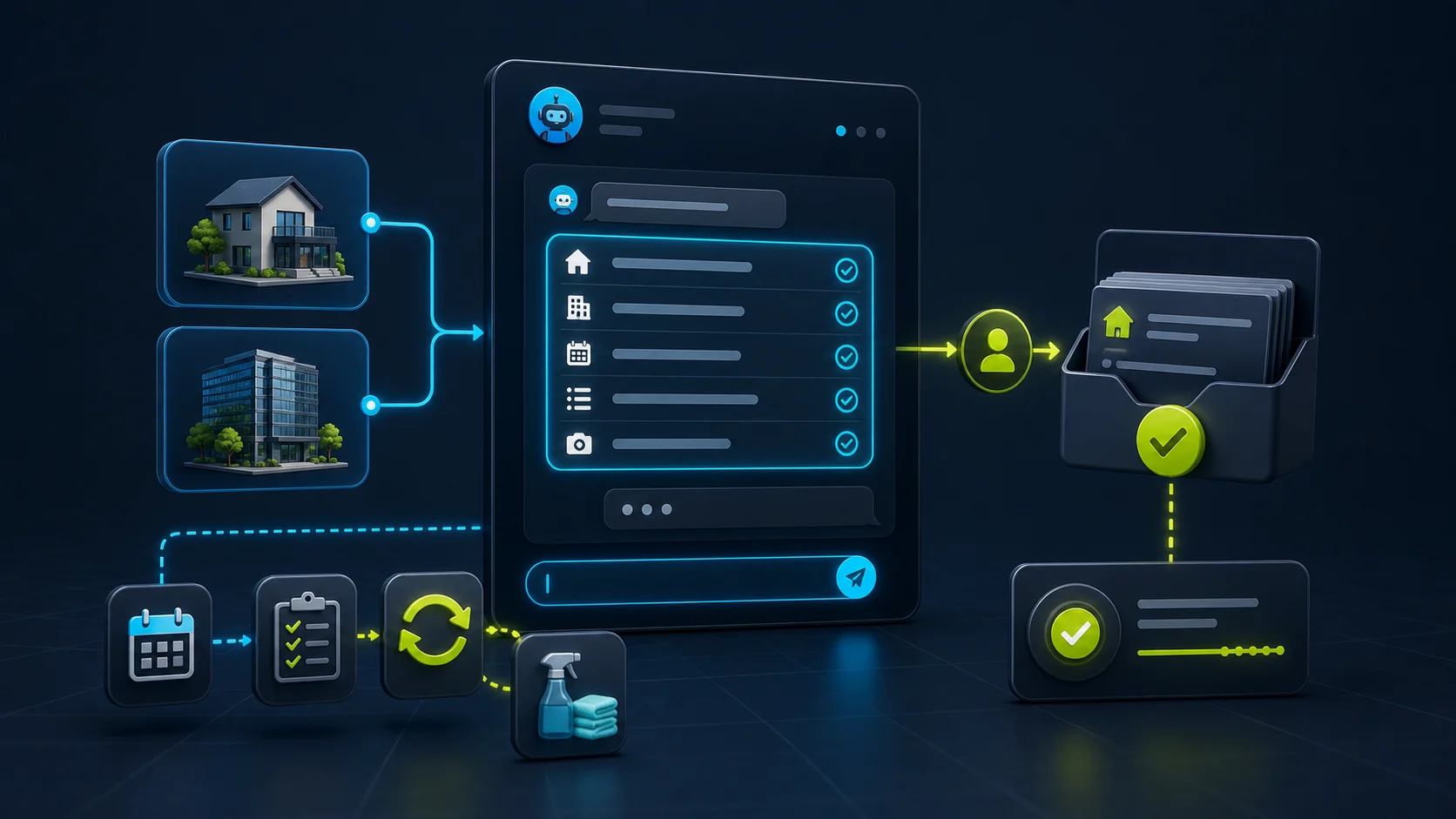
The visitor asks about standard cleaning, deep cleaning, move-out cleaning, Airbnb turnover, office cleaning, or recurring service.
Location, property type, bedrooms and bathrooms, square footage if known, service type, frequency, timing, pets, access notes, and preferred callback path.
The bot can collect context, but final prices, site condition, specialty cleaning, hazardous work, and job commitments stay with people.
The owner, office manager, estimator, or booking coordinator gets a tighter request and can decide whether to quote, inspect, or decline.
What the chatbot should collect
The visitor wants a first clean, weekly or fortnightly service, partial-home cleaning, or a regular cleaner.
Collect location, property type, bedrooms, bathrooms, square footage if known, rooms included, frequency, pets, access notes, timing, and contact details.
The visitor asks about deep cleaning, move-in or move-out cleaning, post-renovation cleaning, or Airbnb turnover.
Ask service type, property condition, rough size, add-ons, deadline, photos or description, access notes, and preferred follow-up path. Keep final price human-reviewed.
The visitor asks about office, retail, strata, school, gym, clinic, or commercial cleaning.
Collect facility type, square footage if known, cleaning frequency, access hours, floor types, special requirements, and contact details. Route walkthrough and contract scope to a person.
The visitor mentions mold, biohazard, hoarding, pest residue, crime-scene cleanup, heavy chemical sensitivity, high ladders, exterior windows, or unknown site condition.
Collect the enquiry as background and route to the approved human path. Do not diagnose, promise suitability, quote, or advise on hazardous cleanup.
The visitor asks about service areas, checklists, supplies, insurance, cancellations, deposits, access, pets, or what happens before a visit.
Answer from approved pages, policy snippets, and Q&A. Stop before making pricing, cleaner, access, or booking promises.
Setup checklist
Write the exact suburbs, ZIP codes, minimum job rules, property types, and service categories the chatbot can mention.
Create approved wording for standard cleaning, deep cleaning, move-out cleaning, Airbnb turnover, commercial cleaning, add-ons, supplies, pets, cancellations, and deposits.
Add service pages, cleaning checklists, service-area notes, access instructions, recurring-service policies, quote policies, and FAQs as sources.
Define the lead fields: name, phone, email if useful, location, property type, bedrooms, bathrooms, square footage if known, service type, frequency, pets, access notes, timing, description, photo path, and preferred callback time.
Tell the chatbot to collect the situation and route it, not promise a price, judge site condition, assign a cleaner, or confirm a job time.
Send every captured lead and transcript to an inbox, CRM, dashboard, or workflow a real person checks.
Review transcripts before letting the bot near exact quote calculators, confirmed bookings, cleaner schedules, route planning, payments, or client-profile updates.
Automation boundary
Ask for contact details, location, property type, bedrooms, bathrooms, square footage if known, service type, frequency, pets, access notes, timing, description, and preferred callback path.
Use service pages, service-area notes, cleaning checklists, recurring-service copy, add-on descriptions, supply policies, cancellation rules, and approved Q&A.
Send specialty cleaning, hazardous work, unclear site condition, commercial walkthroughs, urgent deadlines, and quote-sensitive cases to the approved phone, inbox, or human handoff path.
Final pricing, condition adjustments, deep-clean scope, move-out complexity, commercial contracts, and unusual access constraints need a person and the business's quote process.
Do not let the chatbot diagnose or advise on mold, biohazard, hoarding, pest residue, crime-scene cleanup, heavy chemical sensitivity, high ladders, exterior windows, or unsafe conditions.
Confirmed visit times, cleaner assignment, recurring schedules, route planning, client-profile updates, payments, and accounting sync need proven human-reviewed workflows.
Do not automate first
Specialist tools
If the real problem is missed phone calls, exact quote calculation, recurring schedules, cleaner assignment, route planning, payments, client notes, access instructions, or cleaning CRM sync, a website chatbot may only solve part of it.
For this guide, we kept the shortlist to tools ChatbotEdge can describe from official sources. We do not claim those tools are native cleaning dispatch, route optimization, exact quoting, hazardous-cleaning, cleaner assignment, payment, accounting, or operations systems.
A practical split: use a website chatbot to capture and qualify the enquiry; use a specialist phone, quoting, or operations layer when you need exact prices, confirmed schedules, cleaner routing, recurring jobs, payments, or cleaning CRM workflows.
Sources checked
Product details change. Check the current vendor docs before giving a chatbot permission to handle quotes, confirmed visits, cleaner schedules, route planning, specialty work, payments, accounting, or customer promises.